TraVerse was originally concepted because nobody made the scifi game we wanted to play.
All the science fiction options for tabletop were either too science-fantasy or too rules light.
The only viable option for us was Traveller, and while it has excellent character creation, a large skill list, and a wide variety of equipment, it was missing a few critical elements we were looking for – Impactful Class Abilities, Satisfying Character Progression, and Tactical Combat.
TraVerse was born from this need; a gap in our TRPG lexicon that, for us, demanded to be filled.
core pillars
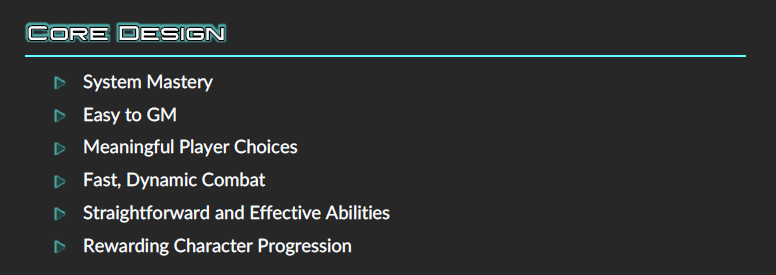
The core narrative and design pillars for TraVerse guide every aspect of the game’s design, from setting and tone to rules and creatures.
narrative pillars
Because characters in TraVerse can use a starship to travel the galaxy, they can find themselves in a variety of environments, each with a distinct tone of play.
This enables GMs to seamlessly mix and match a variety of scifi settings within a single adventure.
We chose to focus on what we considered the five most iconic elements of scifi.
The rules, characters, setting, and creatures of TraVerse were then built to support scifi adventures within these themes.
design pillars
There are many fantastic things the d20 tradition of D&D has innovated over the years, with each edition bringing something new to the table.
3rd edition’s character customization and skills.
4th edition’s tactical combat and monster design.
5th edition’s bounded accuracy and ease-of-use.
With TraVerse, we sought to take the strongest elements from each edition, learn from them, and adapt them for science fiction, updating and innovating where necessary.
guiding principles
With all the science-fantasy TRPGs available, we wanted to assure we were putting the SCIENCE in science fiction.
We knew we wanted a believable, grounded tone with our game, anchored in real history, biology, and physics.
Everything would be plausible, and have an internal logic that made sense.
We also wanted to present characters abilities a straightforward way with abilities that were easy to understand, fun to use, and felt impactful.
From these principles, a list of secondary goals was established that guided our designs.
scifi hardness
When creating a sci-fi property, all franchises have to grapple with the concept of “hardness,” even if they do not consciously do so.
Scifi hardness is not an exact science, but rather a general sense of how close to reality a scifi universe is, determined by a combination of a setting’s narrative tone and technology level.
A setting’s scifi hardness influences what its technology can do, so must be determined early on in a game’s development so it can inform the design process, especially in a game like TraVerse that prominently features weaponry, equipment, tech abilities, psionic abilities, vehicles, and starships.
The Hardness Scale
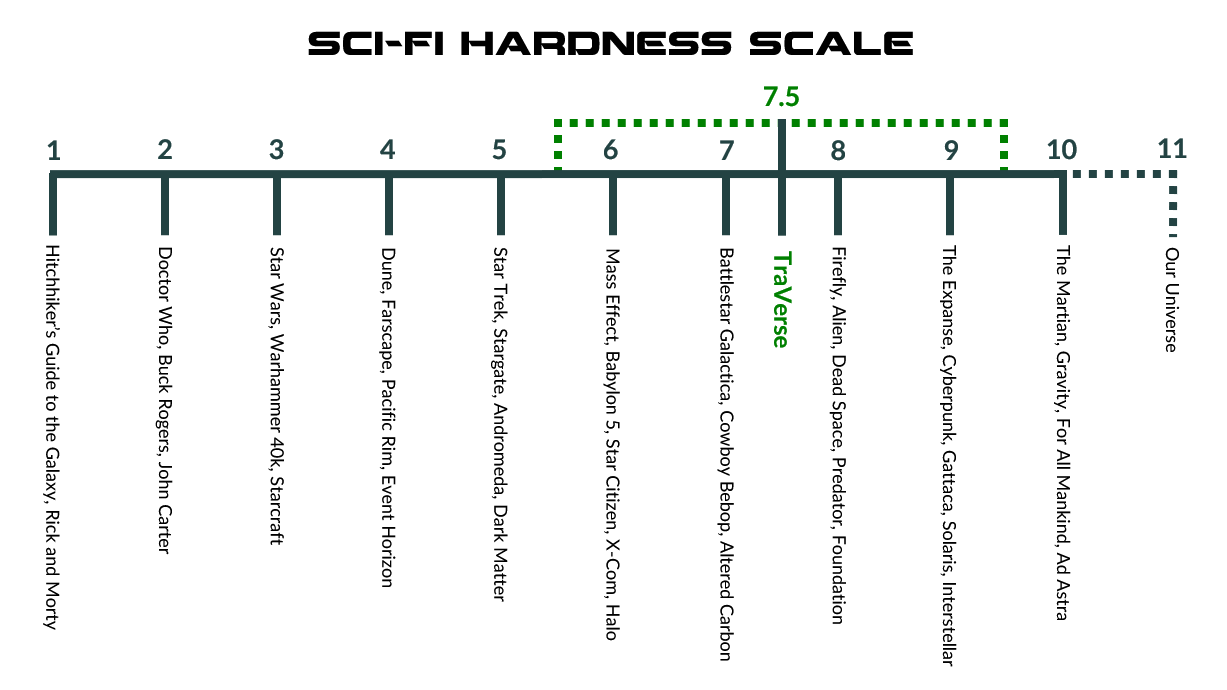
The Sci-Fi Hardness Scale below includes a variety of popular science fiction franchises.
TraVerse is roughly a 7.5 on this scale.
What this means, is that if a GM wants to use TraVerse to run a game in a scifi universe within the green dotted lines, they can likely do so with minimum conversion work. Anything outside this “splash zone” would require a significantly higher amount of conversion work, making a more targeted TRPG a likely better option.